
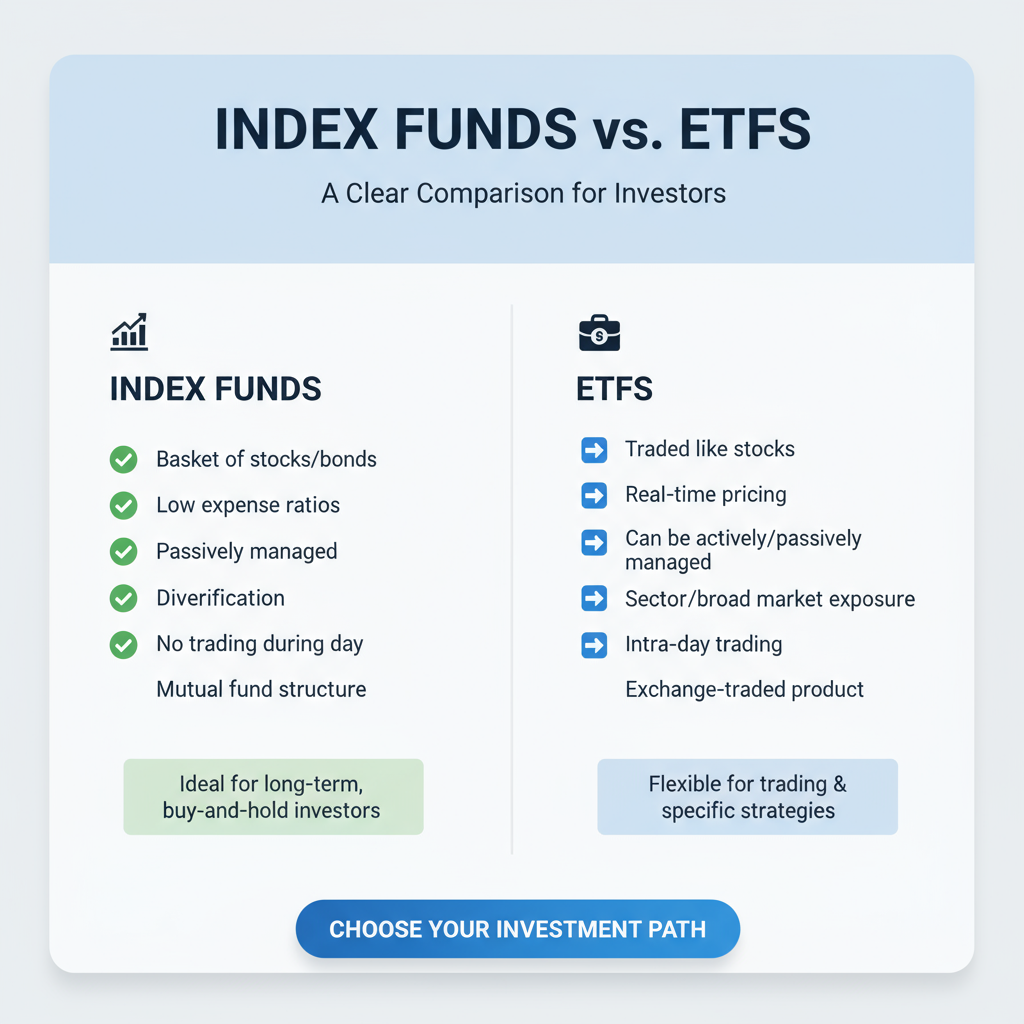
When retail investors think about passive investing, two options always stand out—Index Funds and ETFs (Exchange Traded Funds). Both are designed to mirror the performance of an index such as Nifty 50 or Sensex, but their structure and usability differ in ways that can impact your investing journey.
In this post, we’ll break down how they work, their advantages, and the differences you must know before deciding which one fits your style.
What Are Index Funds?
Index funds are a type of mutual fund that passively replicates a market index. For example, an index fund tracking the Nifty 50 will hold the same 50 companies in the same proportion as the index itself.
Key features of index funds:
- Simple to invest: You can start with a SIP (Systematic Investment Plan) or a lump sum.
- No demat account needed: Buy or sell directly through the fund house or mutual fund platform.
- NAV-based pricing: Transactions happen at the day’s Net Asset Value (NAV), which is calculated once daily.
- Best for long-term investors: Perfect for those who prefer a hands-off approach.
💡 Example: Suppose you invest ₹10,000 in a Nifty 50 index fund today. You’ll get units based on the day’s NAV, regardless of market movements during trading hours.
What Are ETFs (Exchange Traded Funds)?
ETFs also aim to mirror an index like Nifty 50, Bank Nifty, or Sensex—but they work differently. Think of them as mutual funds that trade like stocks.
Key features of ETFs:
- Traded on stock exchanges: You buy/sell ETFs via your demat account.
- Live pricing: The price fluctuates throughout the trading day, just like a stock.
- Intraday trading possible: Investors can take tactical positions or trade short-term.
- Lower expense ratio: Generally cheaper than index funds, but brokerage charges apply.
💡 Example: If the Nifty ETF is trading at ₹200, you can buy it at that price during market hours, and sell it later in the day if the price moves up.
Index Funds vs ETFs – Key Differences
Here’s a side-by-side comparison to help you decide:
| Factor | Index Funds | ETFs |
|---|---|---|
| Investment Mode | Direct via AMC or mutual fund apps | Requires demat + trading account |
| Pricing | Based on NAV, once daily | Real-time market prices |
| Liquidity | High (fund house always buys/sells) | Depends on market volumes |
| Costs | Slightly higher expense ratio, no brokerage | Low expense ratio, but brokerage applies |
| Ease of Use | Beginner-friendly | Better for active investors |
| Best For | Long-term SIP investors | Traders and tactical investors |
Which Is Better for Retail Investors?
The answer depends on your comfort and style:
- Choose Index Funds if:
- You’re new to investing.
- You prefer SIPs and long-term wealth creation.
- You don’t want to deal with demat accounts or live trading.
- Choose ETFs if:
- You already have a demat account.
- You want flexibility and the ability to trade intraday.
- You prefer lower costs and control over entry/exit points.
Final Thoughts
Both index funds and ETFs are excellent tools for passive investing. Neither is “better” in absolute terms—the choice depends on your goals and investing style.
👉 If you want a simple, steady, and beginner-friendly route, index funds are your best bet.
👉 If you’re comfortable with the stock market and want flexibility, ETFs may suit you better.
The key is consistency. Whether you go with index funds or ETFs, staying invested and disciplined is what drives long-term wealth.